
The Pastors of Siloam · 1860–1863
C. H. Thompson
Oberlin-trained minister who led Siloam from 1860, challenged New Jersey's whites-only vote in court, and later served as an Episcopal priest in Louisiana.
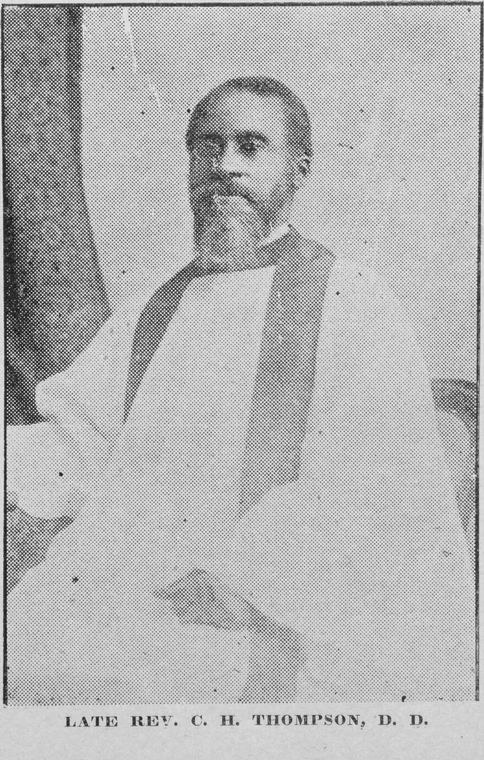
Pastor
At Siloam
Siloam's list of pastors names C. H. Thompson after Amos N. Freeman, from 1860 to 1863. Henry R. Stiles's 1884 history of Kings County gives the same years for Charles H. Thompson. No record of his call to Siloam or of his leaving has been found. A Newark history places him in Newark from 1861, so how his Brooklyn and Newark years overlapped is not yet known.
Life and ministry
Charles H. Thompson was born in 1820 in Little York, Pennsylvania, the son of John Thompson, according to a family history by Teresa Vega. Vega writes that in the 1850s he worked with the American Missionary Association, which sponsored his studies at Oberlin College. Oberlin's archives list Charles Henry Thompson, a theology student, among the college's Black graduates of 1860.
A 1913 history of Newark lists him as pastor of the Plane Street Colored Church there from 1861 to January 1871. In Newark he and Abraham Conover sued election officers who had refused them the vote, as test plaintiffs in a campaign against New Jersey's whites-only franchise. They lost, according to a Rutgers University Libraries exhibit. Vega records a doctor of divinity degree from Avery College in 1870.
He later entered the Episcopal ministry. George F. Bragg's 1922 history of Black Episcopalians records that Bishop J. P. B. Wilmer ordained him a deacon on November 18, 1877, and that he was ordained a priest for Louisiana two years later. According to St. Luke's Episcopal Church in New Orleans, he led the St. Philip's mission there, which later became St. Luke's. The historian Jari C. Honora calls him Louisiana's first Black Episcopal priest. Southern University lists him among its early presidents, for 1882–1883. In 1889 he became pastor of St. Mary's Episcopal Church in Vicksburg, Mississippi. In April 1890 he became the first rector of the new St. Matthew's Church in Detroit. Vega writes that he died in Cincinnati in 1902 and was buried in the Colored American Cemetery near Madisonville.
Family
Vega's family history records that he married Elizabeth Berry of Brooklyn in 1845 and that they had several children, who are not named there.
Sources (10)
- Siloam Presbyterian Church, "Our History," the church's earlier website (2026)
- Henry R. Stiles, ed., The Civil, Political, Professional and Ecclesiastical History … of the County of Kings and the City of Brooklyn, N.Y., from 1683 to 1884, vol. 2, W. W. Munsell, 1884, entry "Siloam Presbyterian Church (colored)," Internet Archive
- Oberlin College Archives, "Negro Graduates of Oberlin College, 1844–1972"
- Teresa Vega, "Our Abolitionist Ancestors: Newark Born and Bred," Radiant Roots, Boricua Branches (family-history blog), 31 Mar 2019
- Frank J. Urquhart, A History of the City of Newark, New Jersey, vol. II, Lewis Historical Publishing, 1913, Plane Street Colored Church section
- Rutgers University Libraries, "Battles for the Ballot in New Jersey," digital exhibit, "Policing the Boundaries of Inclusion"
- George F. Bragg, History of the Afro-American Group of the Episcopal Church, Church Advocate Press, Baltimore, 1922, chapters XI and XXXVI, Internet Archive
- Historic St. Luke's Episcopal Church, New Orleans, "History"
- Jari C. Honora, "Columbia University in New Orleans: Its Short History & The Controversy that Created It," CreoleGen, 24 Nov 2023
- Southern University and A&M College, "History," graduate catalog 2024–2026