
The Pastors of Siloam · 1948–1988
Milton A. Galamison
Siloam's pastor for forty years and a leader of New York City's fight for integrated schools, including the school boycott of February 3, 1964.
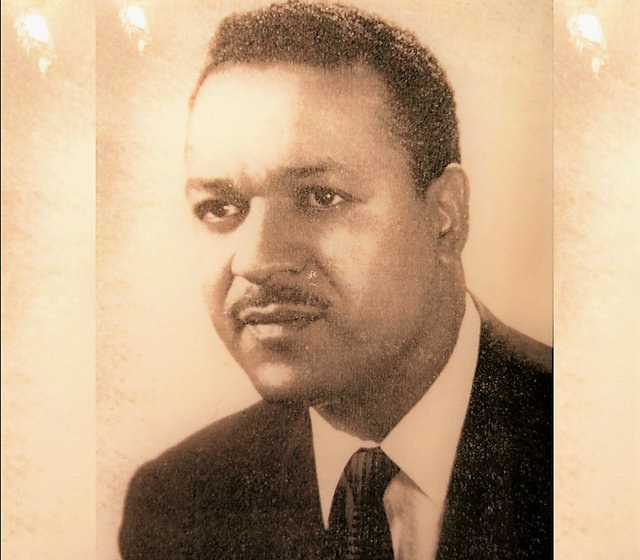
Pastor
At Siloam
Rev. Galamison began his ministry at Siloam in 1948, after the death of Rev. George Shippen Stark. He served the congregation for forty years. The Presbyterian Historical Society describes the Siloam he served as the third-oldest African American Presbyterian church in the country, with about 2,200 members.
The church remembers Siloam as the first Black church to appear on NBC. In 1952 the Brooklyn Eagle photographed him before an NBC camera, under the caption "Boro's first TV service."
The Metropole reports that he directed the 1964 boycott from Siloam. The church's own history credits Siloam, under his leadership, with a large part in the struggle for educational equality and human dignity, a struggle that gained national scope.
His sermons from 1963 to 1965 were digitized in 2022 and can be read online in the Presbyterian Historical Society's Pearl Digital Collections.
Life and ministry
Milton Arthur Galamison was born in 1923. He studied at Lincoln University in Pennsylvania and at Princeton Theological Seminary.
The church remembers him as one of the earliest Black civil-rights leaders in New York City. Much of that work was for the integration of the city's public schools. He was the lead planner of the citywide school boycott of February 3, 1964, and Bayard Rustin was brought in to organize it. That day 464,361 students stayed out of school, about 45 percent of enrollment. The Metropole, the blog of the Urban History Association, calls it the largest civil-rights protest in American history. He led a second boycott on March 16, 1964. It was about half the size of the first.
He was arrested repeatedly in the protests of those years. In 1968 he joined the city's Board of Education, and he served as its vice president in 1968 and 1969. In a WNYC broadcast believed to date from 1969, he restated his belief that the best education is one in which children of different groups learn together in racially balanced schools.
He died in 1988, while still pastor of Siloam.
Family
He made his home in Brooklyn with his wife and son.
Sources (11)
- Siloam Presbyterian Church, "Our History," the church's earlier website (2026)
- Siloam Presbyterian Church, "The Pastors of Siloam," the church's earlier website (2026)
- "Galamison, Milton A. (Milton Arthur), 1923-1988," Civil Rights Digital Library, Digital Library of Georgia, n.d.
- Clarence Taylor, Knocking at Our Own Door: Milton A. Galamison and the Struggle for School Integration in New York City, Columbia University Press, 1997
- "Interview with Milton A. Galamison, June 17, 1964," Robert Penn Warren Civil Rights Oral History Project, Who Speaks for the Negro?, Vanderbilt University, n.d.
- Yasmeen Khan, "Demand for School Integration Leads to Massive 1964 Boycott, in New York City," WNYC SchoolBook, 2016
- Ethan Scott Barnett, "The New York Times and the Movement for Integrated Education in New York City," The Metropole, Urban History Association, 2017
- Adam Sanchez, "The Largest Civil Rights Protest You've Never Heard Of," Rethinking Schools, vol. 34 no. 2, 2019
- "Milton Arthur Galamison and the New York School Boycott," Presbyterian Historical Society blog, 2021
- "New in Pearl: Milton Galamison Sermons," Presbyterian Historical Society blog, 2022
- "Boro's first TV service," Brooklyn Daily Eagle photograph by Dan Fox, CHUR_0557, Brooklyn Public Library, Center for Brooklyn History, 1952